

Understanding Shanghai’s Transit Grid: Where is Hongqiao?
Shanghai is a massive global metropolis spanning over 6,300 square kilometers. To navigate it smoothly, the first thing every traveler needs to understand is its “Two Airports, One Mega-Hub” geography:
- In the East (Pudong): Pudong International Airport (PVG) serves as the city’s primary international gateway, greeting long-haul flights from across the globe.
- In the West (Hongqiao): Sitting on the opposite side of town is the Hongqiao Transportation Hub—a bustling transit nerve center combining domestic flights, international routes, and high-speed rail.
As you can see from our transit layout map above, the western hub is anchored by three distinct landmarks:
1. Hongqiao Railway Station (China’s high-speed rail megastation);
2. Hongqiao Airport Terminal 2 (SHA T2) (the primary terminal for domestic flights);
3. Hongqiao Airport Terminal 1 (SHA T1) (the separate, historic terminal for select regional and international flights).
Notice how the Railway Station and Terminal 2 are bundled tightly together inside the hub box? They are practically neighbors.
In Part 1 of this guide, we dive deep into the centerpiece of this western mega-hub: Hongqiao Airport Terminal 2 (T2)—how it works, how to get around, and how to connect to the rest of the city with ease.
Navigating Terminal 2: Understanding the 4-Level Vertical Layout
To easily find your way around the Hongqiao Transportation Hub, the first thing to grasp is its smart, multi-level vertical design. The complex is organized across four main levels—three above ground (1F to 3F) and one subterranean basement level (B1):

- 3F — Departures, High-Speed Trains & Suburban Railway: This is the main departure hall for domestic flights (ticketing, bag drop, and security). Crucially, 3F also houses the elevated indoor skybridge connecting directly to Hongqiao Railway Station (High-Speed Trains) and the new Suburban Railway (Airport Link Line), alongside a wide range of restaurants and the airport hotel.
- 2F — Parking & E-Hailing (Didi): Dedicated to parking structures (P5–P8) and the designated pickup zones for app-based ride-hailing services (E-Hailing / Didi).
- 1F — Arrivals, Traditional Taxis & Luggage Services: Where you exit after collecting your baggage. Outside the terminal doors, you’ll find the official taxi queue, airport shuttle bus pickup points, luggage storage (Left Luggage), and a medical first-aid station.
- B1 — Metro Subway & Regional Transit: Take the elevators or escalators down to the basement to access the Shanghai Metro (Line 2 & Line 10), city public buses, and the long-distance coach terminal.

Seamless Walk to the High-Speed Railway Station:
Because Terminal 2 is physically integrated with Hongqiao Railway Station, you never need to step out into the rain or cold. Simply follow the clear bilingual overhead signage on 3F or B1—a comfortable, flat 10-minute indoor walk is all it takes to transition from your flight terminal straight to your high-speed train platform!
Transit Connections: Navigating Level B1 & Level 2F
Once you land and collect your bags at 1F Arrivals, you’ll likely need to head to Level B1 for rail transit or Level 2F if you booked a ride-hailing car. Here is exactly how to connect to each mode of transport:
Level B1: The Mega Underground Transit Hub

Once you arrive at Level B1, navigating is remarkably foolproof. Both on the floor beneath your feet and overhead, you’ll find prominent, color-coded signage guiding you toward Metro Line 2, Line 10, the Airport Link Line (Suburban Railway), and Hongqiao Railway Station.


If you are coming from the opposite direction toward Terminal 2, you’ll spot clear bilingual signs in both English and Chinese every few steps, complete with exact walking distances. You truly don’t have to worry about taking a wrong turn.

Additionally, right at the central transfer area on Level B1, there is a fully staffed Customer Service Center (Service Desk) ready to assist you with inquiries, directions, and special assistance whenever you need a helping hand.
Level 2F: Ride-Hailing (Didi / E-Hailing Pickup)
If you prefer catching a car using smartphone apps (such as Didi or Alipay’s built-in ride-hailing feature), take the elevators or escalators up to Level 2F:

- Dedicated Pickup Garages (P5–P8): App-hailed cars are not permitted to pick up passengers at the curbside on 1F. Instead, all pickups are organized inside the Level 2F parking structures.
- Spotting the Garage Entrance: As shown in the photo above, clear illuminated overhead signs right by the sliding glass doors will guide your way: turn left for Garages P5–P6, or continue straight for Garages P7–P8.
- How to Meet Your Driver: Once your ride is confirmed in your app, check your assigned pickup zone (for example, Garage P6, Zone B). Walk through the doors into the designated parking structure and wait at the numbered pillars for a smooth, stress-free pickup.
(💡 Taxi Reminder: If you prefer taking a traditional metered taxi rather than using an app, simply stay on 1F Arrivals and follow the signs directly to the outdoor taxi queue!)
Level 1F: Navigating the Arrival Area & Key Facilities
As you step off your plane at Hongqiao Terminal 2, you will enter the arrival concourse on Level 1F. The layout is clean and user-friendly, guiding you smoothly from the jet bridge to the city transit exits.

1. From Flight Gates to Baggage Claim
- Domestic Arrival Gates (21–75):
Whether your flight docks at a jet bridge or arrives via an apron bus, follow the overhead signs along the green corridor toward the central Checked Baggage Claim Area . - Helpful Amenities Before Exiting:
Inside the secure baggage claim hall around Carousels 21–34, you will find several thoughtful facilities before stepping through the final exit:- Locker / Changing Rooms : A lifesaver for travelers flying in from colder northern cities or warmer tropical climates—allowing you to freshen up and switch clothes before heading out.
- Baggage Inquiries & Medical First Aid: Located adjacent to the carousels in case your luggage is delayed or you need immediate medical attention.

2. The Public Arrival Hall (Exits 1–4)
Once you pick up your luggage and walk through sliding glass Exits 1, 2, 3, or 4, you will enter the spacious public Arrival Hall :
- Free Wi-Fi Kiosks :
No local SIM card yet? Look for the self-service Wi-Fi kiosks near the inquiry counters. International travelers can simply scan their passport or use mobile phone SMS verification to receive an instant Wi-Fi access code for terminal internet. - Information & Meeting Point :
Centrally located help desks are available if you need directions, alongside designated meeting points if someone is picking you up. - Left Luggage & Lost and Found :
If you have a long layover and want to explore Shanghai unburdened, you can safely store your bags at the official Left Luggage counter on 1F.

3. Ground Transport Exits from 1F
From the 1F Arrival Hall, your next steps depend on how you plan to travel into the city:
- For Traditional Metered Taxis :
Walk straight out the terminal curbside doors on 1F, following the signs directly into the sheltered, organized taxi waiting queue. - For Metro, High-Speed Trains & Suburban Rail :
Look for the prominent down-escalators. Taking these down to Level B1 connects you seamlessly to Metro Lines 2 & 10, the Airport Link Line to Pudong, and the pedestrian bridge to Hongqiao Railway Station. - (Note: If you have a domestic connecting flight, look for the Transfer signs directing you up to Level 2F.)
Level 3F & M2: Departures, Check-In & Boarding Guide
Level 3F is the vibrant departure hub of Hongqiao Terminal 2. Whether you arrive by taxi at the elevated curbside drop-off or walk over from the High-Speed Railway Station via the 3F indoor skybridge, everything you need for departure is laid out in a clean, logical sequence.

1. Check-In Concourse: Islands A through H
The spacious check-in hall is divided into alphabetized island clusters running from Island A to Island H:

- Finding Your Airline: Check the overhead digital flight information displays at the entrance doors to locate your designated check-in row (A–H) for bag-drop and boarding passes.
- Pre-Flight Travel Services:
- Baggage Wrapping & Oversized Baggage : Located at the outer edges near Island A and Island F for odd-sized gear, sports equipment, or protective plastic wrapping.
- Banking & Currency : Bank branches and ATMs are on hand on 3F if you need cash or financial services before flying.
- Wi-Fi Kiosks & Information: Scan your passport at the self-service kiosks near the information desks to grab your airport Wi-Fi code.


2. Unique Amenities in the Public Hall
Hongqiao T2 features several thoughtful, cultural amenities rarely seen in typical transit hubs:
- Hong Qiao Reading Lounge (虹桥书房):
A tranquil, cultural public reading space where you can sit down, browse books, and unwind away from the bustling terminal concourse. - Qin Xin Tang (沁心堂 – Massage & Wellness):
A dedicated relaxation center providing professional massage services (such as foot, shoulder, and neck massages)—ideal for relieving travel fatigue and recharging your body before boarding. - Pet Lounge (宠物候机厅): A dedicated, friendly space catering to passengers traveling with their furry companions.


3. Security Screening & Airside Gates (21–75)
Once your bags are checked, proceed through the centralized Security Check Area located directly behind Check-In Islands A–D:
- Boarding Piers (Gates 21–75):
After clearing security, the airside terminal branches into long, spacious gate concourses. (Note: Gates 41–45 are designated for remote apron bus boarding down on the lower level). - Explore Level M2 (Family & Wellness Mezzanine):
Take the escalators up to the M2 Mezzanine inside the secure airside area:- Children’s Playground : A dedicated play area where kids can burn off energy before long flights.
- Baby Care Rooms & Medical First Aid: Clean, private nurseries and medical help for traveling families.
- Airline VIP Lounges : Premium lounges (China Eastern, Air China, etc.) are situated on both 3F and M2 for eligible travelers.
Essential Passenger Services: Free Wi-Fi, Payments , Currency Exchange & Hotlines
To ensure a smooth journey, Hongqiao Terminal 2 offers fully integrated foreigner-friendly amenities—from getting online without a local SIM card to seamless card payments and 24/7 customer support.
1. How to Connect to Free Terminal Wi-Fi
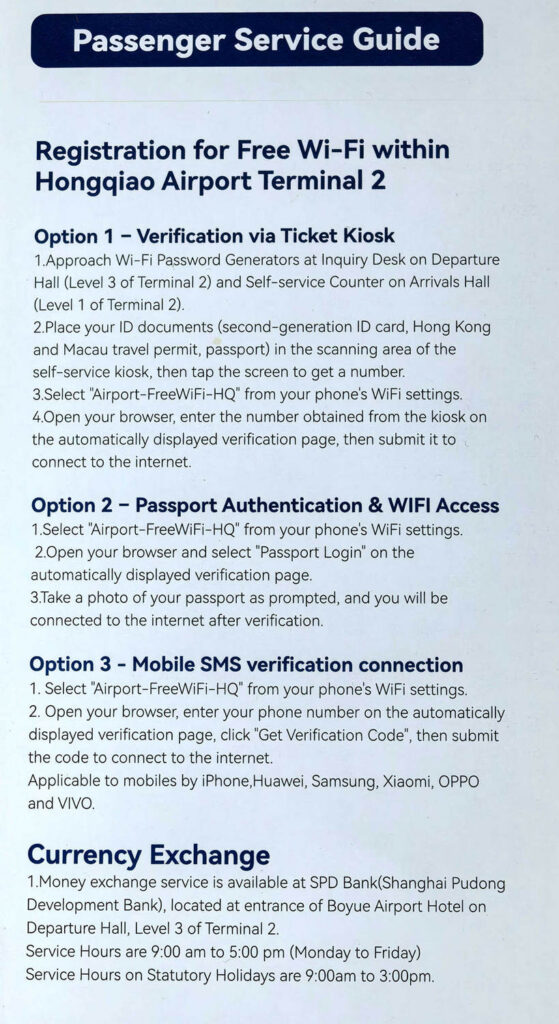
Staying connected as soon as you land is effortless. The airport operates a unified free network: Airport-FreeWiFi-HQ. If you don’t have international roaming or a Chinese phone number, you have three flexible ways to get online:
- Option 1 — Passport Verification at Self-Service Kiosks (Recommended for First-Timers):
Locate the Wi-Fi Password Kiosks positioned near the Inquiry Desks on Level 3 (Departures) and the Self-Service Counters on Level 1 (Arrivals). Place your passport on the scanner to instantly generate a login access code. Connect to the Wi-Fi on your device, open your browser, enter the code, and you’re online! - Option 2 — Direct Passport Photo Upload via Browser:
Connect to Airport-FreeWiFi-HQ, select “Passport Login” on the automatically launched login portal, and snap a clear photo of your passport’s photo page using your phone’s camera. - Option 3 — Mobile SMS Verification:
If your phone has active mobile roaming, simply input your mobile number on the login page to receive an SMS verification code.
2. Currency Exchange & Accepted Payment Methods
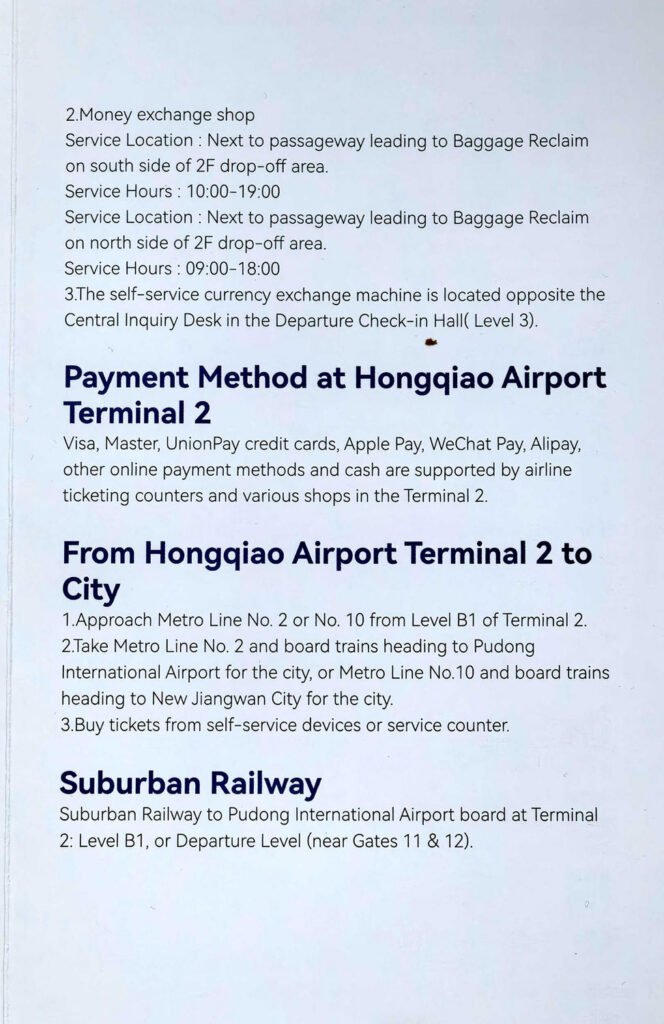
Many international travelers worry about payment barriers in China, but Hongqiao Terminal 2 is exceptionally accommodating:
- Broad Payment Acceptance:
Airline ticketing counters, dining spots, and retail shops throughout Terminal 2 widely accept international credit cards (Visa, Mastercard, UnionPay), Apple Pay, WeChat Pay, Alipay, and cash (RMB). - Currency Exchange & Banking:
- Bank Branch: Shanghai Pudong Development Bank (SPD Bank) is located at the entrance of Boyue Airport Hotel on Level 3 (Departures) (Mon–Fri 9:00 AM–5:00 PM; Holidays 9:00 AM–3:00 PM).
- Exchange Counters: Two dedicated currency exchange shops are situated on Level 2F (north and south sides along the passageways leading to Baggage Reclaim).
- Self-Service Kiosk: An automated currency exchange machine stands directly opposite the Central Inquiry Desk on Level 3.
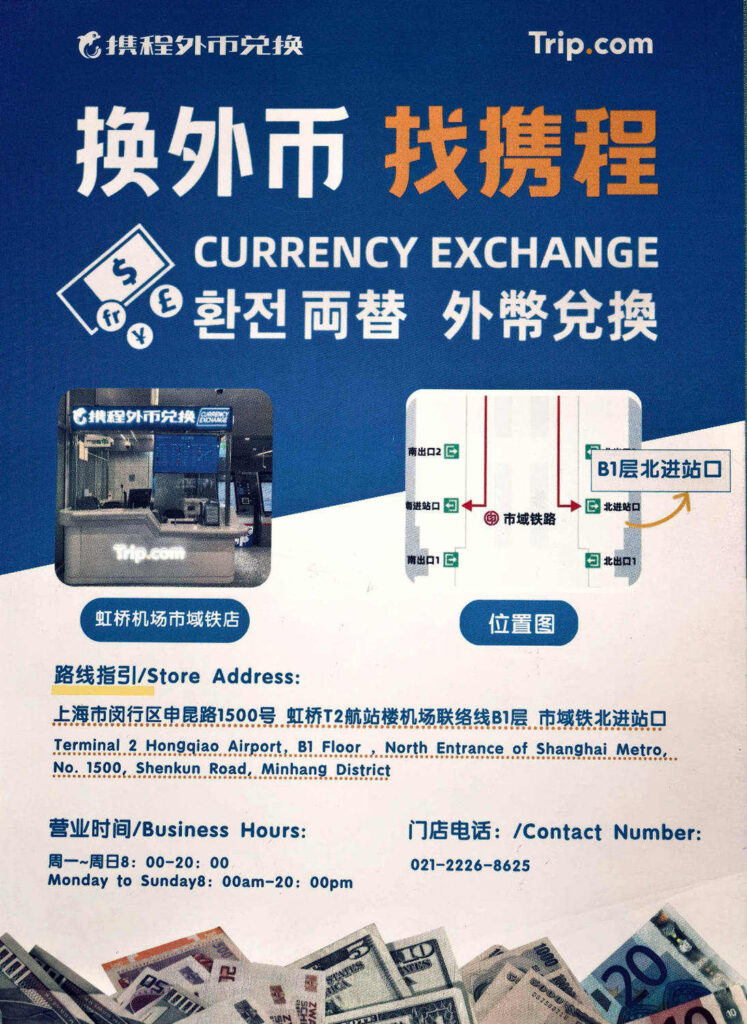
- Trip.com (Ctrip / 携程) Currency Exchange — Level B1 (Airport Link Line Entrance):
- If you are heading down to Level B1 for the metro or express rail, you’ll find an exceptionally convenient exchange counter operated by China’s leading travel platform, Trip.com . It is located right at the North Entrance of the Airport Link Line (Suburban Railway ).
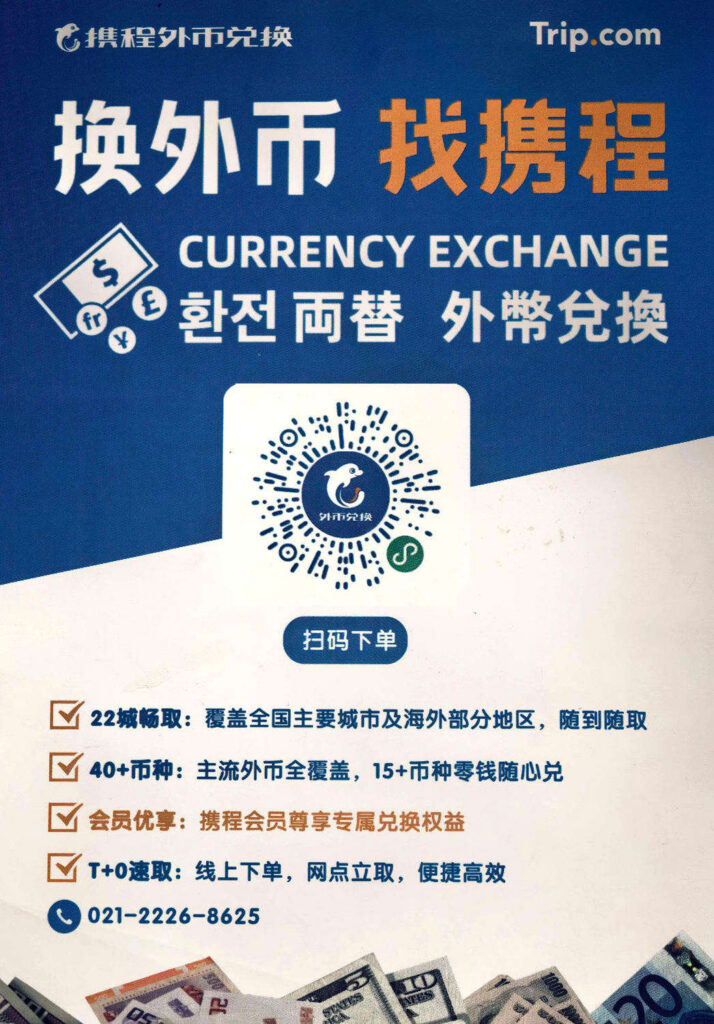
- Wide Currency Coverage: Supports over 40 major international currencies (including small-denomination notes for 15+ currencies). Travelers can also scan their QR code to place an order online and pick up cash on the spot (T+0 instant pickup).
- Transparent Fee: Charges a flat service fee of RMB 38 (approx. $5.30 USD) per transaction.
- Business Hours: Open daily (Monday – Sunday) from 8:00 AM to 8:00 PM.
- Contact Number: +86-21-2226-8625 (or 021-2226-8625 locally).
3. Crucial Service Hotlines (Save to Your Phone!)
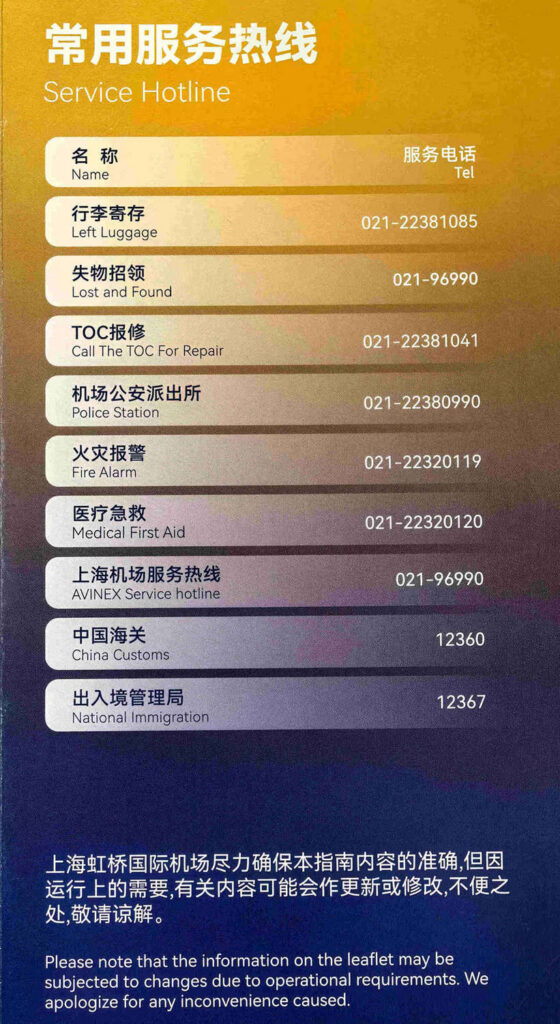
If you ever run into a flight delay, lose an item, or encounter a medical issue, Hongqiao Airport operates a reliable 24/7 centralized customer support system.
- 📞 Official Shanghai Airport Service Hotline (AVINEX): +86-21-96990 (dial 021-96990 if using a local Chinese phone line)
- This is your one-stop master hotline for all airport inquiries, terminal directions, flight schedules, and Lost & Found across both Hongqiao and Pudong airports.
- Other Handy Emergency Numbers:
- Medical First Aid: 021-22320120
- Airport Police (派出所): 021-22380990
- Left Luggage (行李寄存): 021-22381085
- China Customs Hotline: 12360
- National Immigration Administration (NIA): 12367
Conclusion: Your Gateway to Shanghai and Beyond
Shanghai Hongqiao International Airport Terminal 2 is far more than a bustling domestic aviation hub—it is a brilliantly engineered, multi-modal crossroads where flights, high-speed rail, suburban express lines, and the city metro converge under one roof. With its intuitive four-level vertical layout, extensive foreigner-friendly amenities, and clear bilingual wayfinding, navigating this massive complex is smooth and stress-free once you know what to look for.
🔗 Essential Reading to Complete Your Shanghai Journey!
Now that you’ve mastered Hongqiao Terminal 2, make sure your onward transit across Shanghai is just as seamless:
- 🚇 Heading Downtown by Subway?
Before you head down to Level B1 to catch Metro Line 2 or Line 10, learn how to tap your contactless international credit card at the gates, use mobile apps, and ride like a seasoned local:
👉 Exploring Shanghai by Metro Series: Part 1 – How to Buy Tickets and Ride for First-Time International Visitors - 🚅 Connecting Directly to Pudong Airport (PVG)?
Need to transfer between Shanghai’s two airports without dragging your luggage through city traffic? Discover how the express Airport Link Line gets you from Hongqiao to Pudong in just 40 minutes:
👉 The Shanghai Airport Link Line: A High-Speed Bridge Between Pudong and Hongqiao Airports
Stay tuned for Part 2 of our Hongqiao Hub Series, where we step across the concourse to explore the mighty Shanghai Hongqiao Railway Station! Safe travels, and welcome to Shanghai!